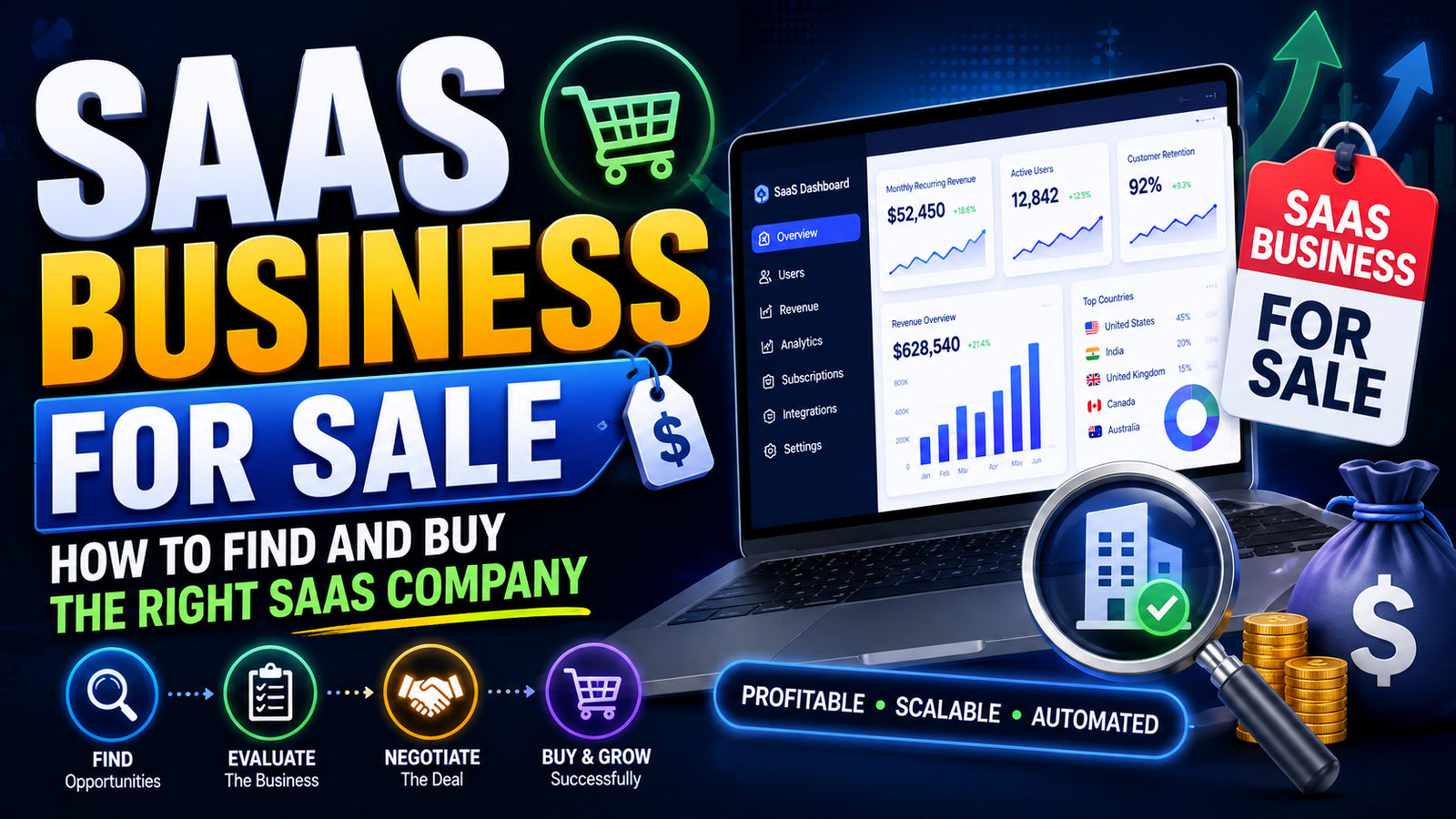

Looking for a SaaS business for sale can be an attractive option for entrepreneurs who want to enter the software industry without building a product from zero.
Instead of spending months or years developing a product and acquiring your first customers, buying an existing SaaS business can give you access to an established product, customers, revenue, infrastructure, and brand.
However, not every SaaS business for sale is a good acquisition.
A business generating recurring revenue may still have high churn, declining traffic, technical debt, customer concentration, or excessive dependence on its founder.
That’s why you need to evaluate the business behind the software, not just the software itself.
What Is a SaaS Business for Sale?
A SaaS business for sale is a software company or online software product whose owner is looking for a buyer.
Depending on the business, an acquisition may include:
- SaaS application
- Source code
- Domain name
- Brand
- Customer accounts
- Subscription revenue
- Website
- Database
- Documentation
- Social media accounts
- Email list
- Marketing assets
- Third-party integrations
- Business operations
The exact assets included in a transaction should be clearly defined in the purchase agreement.
Purchase SaaS: Click Here
Where Can You Find SaaS Businesses for Sale?
There are several places where buyers can search for SaaS acquisition opportunities.
1. SaaS Acquisition Marketplaces
Dedicated marketplaces make it easier to discover software businesses currently available for acquisition.
Examples include:
- Flippa
- Acquire.com
- Empire Flippers
- Buy Sell Startups
- SaaS-specific marketplaces
Flippa currently lists thousands of SaaS businesses and websites, covering both B2B and B2C software products.
Buy Sell Startups also lists SaaS companies ranging from small products and micro-SaaS businesses to larger opportunities.
2. Directly From Founders
Not every SaaS business is publicly listed.
You can identify software products in a particular niche and contact founders directly.
This can sometimes provide opportunities before they reach a public marketplace.
3. Business Brokers
For larger SaaS acquisitions, specialized brokers can help buyers find businesses, evaluate opportunities, negotiate transactions, and coordinate the acquisition process.
4. Acquisition Communities
Founder communities, startup networks, and investor groups can also provide opportunities that aren’t publicly advertised.
SaaS Businesses for Sale: What Can You Buy?
SaaS acquisition opportunities come in many sizes.
Micro-SaaS
Small software products often operated by one founder or a very small team.
Typical characteristics:
- Small customer base
- Lower revenue
- Low operating costs
- Limited team
- Simple product
Bootstrapped SaaS
An independently built SaaS that has developed recurring revenue without relying heavily on venture funding.
B2B SaaS
Software sold to businesses.
Examples include:
- CRM
- HR software
- Marketing software
- Accounting tools
- Analytics
- Project management
B2C SaaS
Software sold directly to consumers.
Examples include:
- Productivity tools
- AI applications
- Personal finance software
- Education tools
- Creative applications
AI SaaS
Software where AI is an important part of the product.
AI SaaS has become a particularly active area of the acquisition market, but buyers should still evaluate whether the AI functionality creates durable customer value rather than simply relying on an AI API wrapper.
Get Your SaaS: Click Here
How Much Does a SaaS Business Cost?
There is no fixed price for a SaaS business.
The asking price can depend on:
- MRR
- ARR
- Profit
- Growth rate
- Customer retention
- Churn
- Market size
- Product quality
- Competitive position
- Traffic sources
- Founder involvement
Current marketplace listings demonstrate how widely prices can vary. For example, public SaaS listings range from relatively small acquisitions to businesses asking hundreds of thousands or millions of dollars.
Therefore, don’t evaluate an opportunity based only on its asking price.
SaaS Valuation: What Determines the Price?
One of the simplest ways to begin evaluating a SaaS business is to look at its recurring revenue and profitability.
For example:
MRR = $10,000
Annualized recurring revenue would be:
ARR = $120,000
But that does not mean the business is automatically worth a specific multiple of $120,000.
The valuation can change significantly depending on:
- Revenue growth
- Profit margins
- Churn
- Customer concentration
- Market opportunity
- Founder dependency
- Competitive advantage
- Product maturity
A growing SaaS with strong retention can be worth substantially more than a similar-sized SaaS with declining revenue.
10 Things to Check Before Buying a SaaS Business
1. Verify Revenue
Never rely only on screenshots supplied by the seller.
Where appropriate, verify revenue through:
- Payment processor records
- Bank statements
- Accounting records
- Subscription systems
- Tax records
Revenue verification is one of the most important parts of SaaS due diligence.
2. Analyze MRR and ARR
Look at revenue over time rather than just the current number.
For example:
| Period | MRR |
|---|---|
| January | $5,000 |
| February | $5,400 |
| March | $5,900 |
| April | $6,300 |
| May | $6,800 |
| June | $7,200 |
A consistent upward trend tells a very different story from a SaaS that reached $7,200 MRR through a temporary spike.
3. Check Churn
Churn shows how many customers or how much recurring revenue is being lost.
High churn can indicate:
- Weak product-market fit
- Poor customer support
- Pricing problems
- Strong competition
- Low customer satisfaction
Don’t look only at customer acquisition.
Retention matters just as much.
4. Understand Where Customers Come From
Ask:
How does this SaaS acquire customers?
Possible channels include:
- SEO
- Google Ads
- Social media
- Content marketing
- Affiliates
- Partnerships
- Cold outreach
- Product-led growth
- Marketplaces
A SaaS that receives 90% of its customers from one advertising channel may have more risk than a business with diversified acquisition channels.
5. Check Customer Concentration
Suppose a SaaS has 100 customers.
That sounds attractive.
But imagine that 50% of revenue comes from one customer.
That’s a significant risk.
You should understand:
- Number of customers
- Revenue per customer
- Largest customers
- Customer concentration
- Customer retention
- Enterprise vs individual customers
6. Review the Source Code
If you’re acquiring the software itself, understand exactly what you’re buying.
Review:
- Source code
- Git repositories
- Database
- APIs
- Hosting
- Deployment process
- Dependencies
- Third-party services
- Documentation
- Technical debt
If you aren’t technically qualified to evaluate the codebase, consider hiring an independent technical expert.
7. Check Intellectual Property
Make sure the seller has the right to transfer the software and related intellectual property.
Check ownership of:
- Source code
- Domain
- Trademark
- Design assets
- Documentation
- Customer data
- Images
- Third-party licenses
This should be handled carefully with appropriate legal advice.
8. Understand Founder Dependency
Ask:
What happens if the founder leaves tomorrow?
If the founder personally handles:
- Development
- Sales
- Customer support
- Marketing
- Infrastructure
- Product decisions
then the transition may be difficult.
A well-documented business with automated processes is generally easier to take over.
9. Analyze Traffic and SEO
If organic traffic generates customers, examine:
- Google Search Console data
- Google Analytics data
- Top landing pages
- Organic keywords
- Backlink profile
- Traffic trends
- Brand searches
Don’t buy a SaaS solely because it currently receives significant Google traffic.
You need to understand why it ranks and whether that traffic is sustainable.
10. Calculate Real Profit
Revenue isn’t profit.
For example:
Revenue: $20,000/month
Expenses:
- Hosting: $1,000
- Software: $1,000
- Support: $3,000
- Marketing: $4,000
- Development: $3,000
Operating profit: $8,000/month
This is a much more useful figure for evaluating the economics of the business.
SaaS Due Diligence Checklist
Before making a serious offer, investigate:
Financial
- MRR
- ARR
- Revenue history
- Expenses
- Profit
- Refunds
- Payment processor records
Customers
- Customer count
- Churn
- Retention
- Customer concentration
- Average revenue per customer
Product
- Source code
- Infrastructure
- Database
- Technical debt
- Security
- Product roadmap
Marketing
- SEO traffic
- Paid traffic
- Backlinks
- Email list
- Social accounts
- Acquisition channels
Legal
- Intellectual property
- Contracts
- Licenses
- Privacy policies
- Terms of service
- Outstanding disputes
Red Flags When Looking at a SaaS Business for Sale
Be particularly careful if you see:
🚩 Unverified Revenue
The seller claims large revenue but won’t provide reasonable verification.
🚩 Declining MRR
Revenue has been consistently falling before the sale.
🚩 Extremely High Churn
Customers continuously cancel subscriptions.
🚩 One Acquisition Channel
Most customers depend on one unstable source.
🚩 One Customer Generates Most Revenue
Losing one account could destroy the economics.
🚩 Founder Does Everything
The business can’t operate without the seller.
🚩 Poor Technical Documentation
You may spend significant money just understanding the system.
🚩 Technical Debt
The product works today but requires major redevelopment.
🚩 Unrealistic Valuation
The seller’s asking price is based on potential rather than actual business performance.
Buy a SaaS Business vs Build One
| Buy an Existing SaaS | Build a SaaS |
|---|---|
| Existing product | Start from scratch |
| Existing customers | Find first customers |
| Existing revenue | No initial revenue |
| Faster entry | Longer development |
| Higher upfront cost | Development cost spread over time |
| Existing problems | Product-market risk |
| Requires due diligence | Requires validation |
| Less control initially | Full control |
If you have capital but limited time, acquisition can be attractive.
If you have technical skills, limited capital, and a strong product idea, building may make more sense.
Best SaaS Businesses to Look For
Instead of simply searching for the cheapest SaaS business for sale, look for businesses with:
Real Problem
→ Customers actually need the product.
Recurring Revenue
→ Customers continue paying.
Low/Manageable Churn
→ Customers aren’t leaving rapidly.
Healthy Margins
→ Revenue isn’t being consumed by operating costs.
Diversified Acquisition
→ Customers don’t depend on one channel.
Low Founder Dependency
→ The business can operate without the original founder.
Clear Growth Opportunities
→ You can identify realistic ways to increase revenue.
Where to Browse SaaS Businesses for Sale
You can start your research with established marketplaces.
- Flippa SaaS Businesses for Sale — large marketplace with thousands of SaaS listings.
- Buy Sell Startups SaaS Marketplace — focused on startups, micro-SaaS, and smaller acquisition opportunities.
- BusinessesForSale SaaS Listings — broader business marketplace with SaaS listings across different countries.
- KeyQuire SaaS Businesses for Sale — smaller marketplace emphasizing verified financials and escrow.
- SaaSMarket Marketplace — SaaS-focused marketplace with verified listings.
These marketplaces have different listing sizes, verification processes, fees, and transaction structures, so compare the platform before committing to a deal.
How to Buy a SaaS Business
A practical acquisition process looks like this:
Step 1 — Set your budget
Determine how much capital you can realistically invest.
Step 2 — Choose your criteria
For example:
B2B SaaS + profitable + $5K–$20K MRR + low churn + low founder dependency
Step 3 — Find listings
Search marketplaces and direct founder opportunities.
Step 4 — Shortlist businesses
Compare revenue, growth, price, churn, customers, and product quality.
Step 5 — Contact the seller
Request additional information and ask detailed questions.
Step 6 — Perform due diligence
Verify financial, technical, customer, marketing, and legal information.
Step 7 — Negotiate
Discuss price, payment terms, transition support, and assets included in the transaction.
Step 8 — Complete the transaction
Use appropriate legal and financial professionals and a suitable transaction/escrow structure.
Step 9 — Take over
Transfer the product, infrastructure, accounts, customer relationships, documentation, and operations.
Is Buying a SaaS Business Worth It?
It can be, but the acquisition itself doesn’t guarantee success.
The best opportunity isn’t necessarily the SaaS with the highest MRR.
A smaller SaaS with:
- Strong retention
- Healthy margins
- Loyal customers
- Stable traffic
- Low founder dependency
- Clear growth opportunities
may be a better acquisition than a much larger business with declining revenue and technical problems.
The goal is not simply to find a SaaS business for sale.
The goal is to find a SaaS business where the price, fundamentals, risks, and growth opportunities make sense together.
Frequently Asked Questions
Where can I find SaaS businesses for sale?
You can search SaaS acquisition marketplaces, business brokers, founder communities, and direct outreach opportunities.
How much does a SaaS business cost?
Prices vary significantly depending on recurring revenue, profit, growth, churn, customers, market, and other factors.
What is the best SaaS business to buy?
Look for a business with verified revenue, strong customer retention, healthy margins, diversified acquisition channels, manageable technical complexity, and realistic growth opportunities.
Should I buy a profitable SaaS or a growing SaaS?
It depends on your strategy. A profitable SaaS can provide cash flow, while a rapidly growing SaaS may offer greater expansion potential but can carry more risk.
Can beginners buy a SaaS business?
Yes, but beginners should start with an acquisition size they can understand and afford. For technical and legal due diligence, professional assistance can be valuable.
Is a micro-SaaS worth buying?
It can be. Micro-SaaS businesses can have relatively simple operations and lower acquisition prices, but you still need to verify revenue, customers, churn, technology, and growth potential.
Final Thoughts
A SaaS business for sale can give you a shortcut into software entrepreneurship, but buying the wrong business can be expensive.
Don’t get distracted by phrases such as “passive income,” “AI-powered,” “huge potential,” or “easy to scale.”
Look at the evidence:
Revenue → Profit → Growth → Churn → Customers → Traffic → Technology → Risks → Price
If those numbers and fundamentals make sense, you may have an acquisition worth investigating further.
SEO/E-E-A-T note: For your actual page, make this stronger by adding real marketplace examples, original screenshots/data, an author with relevant acquisition/business experience, sources for valuation claims, and a clearly dated “last updated” section. Don’t make unsupported claims like “best SaaS marketplace” or invent valuation multiples. Current acquisition sources show that marketplace inventories and asking prices change frequently, so those details should be refreshed regularly.