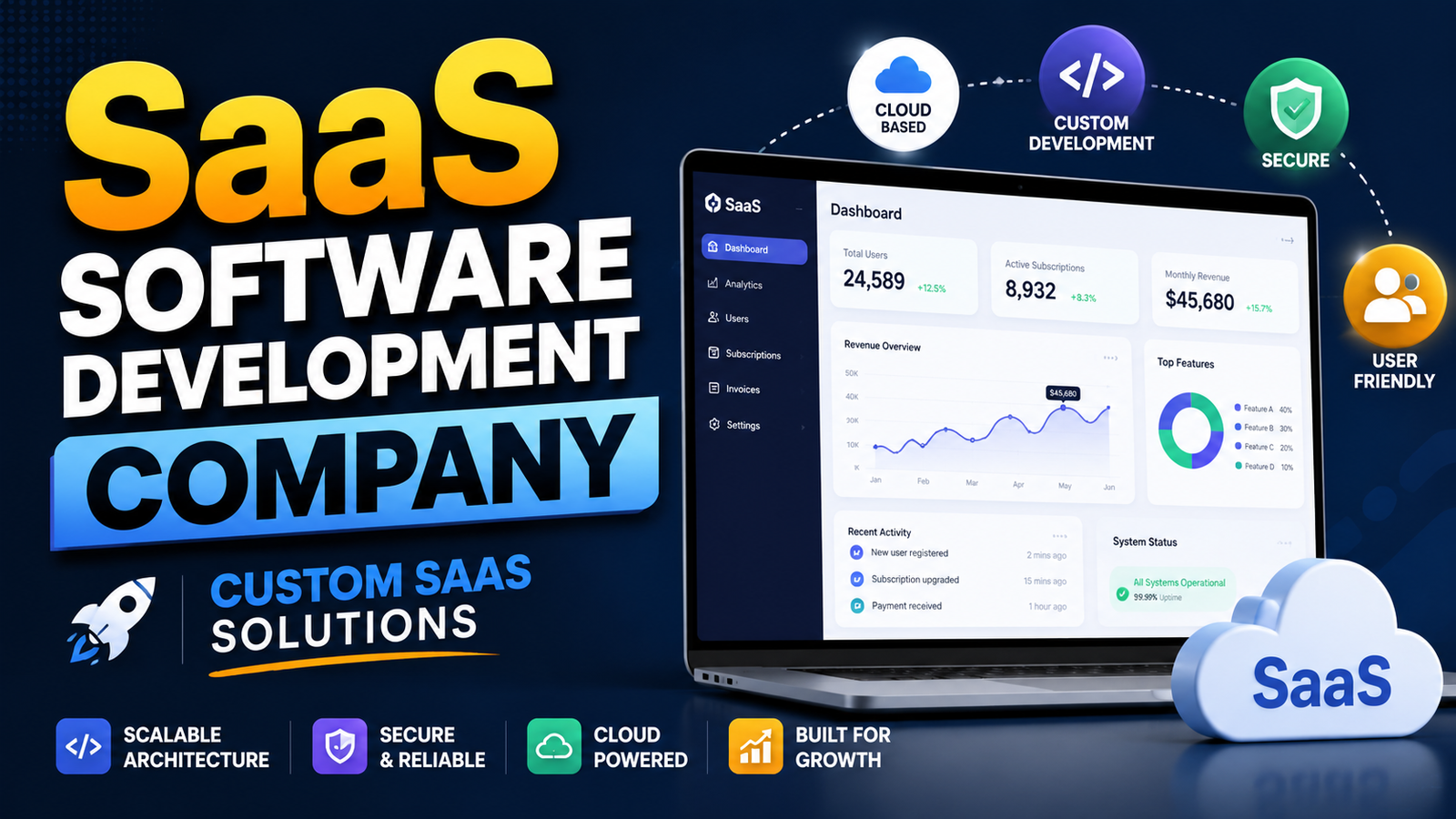

Building a successful SaaS product requires more than writing software. Your product needs reliable architecture, an intuitive user experience, secure data management, subscription billing, integrations, and infrastructure that can scale as your customer base grows.
We are a SaaS software development company helping startups, entrepreneurs, and businesses turn software ideas into scalable SaaS products.
From MVP development to full-scale SaaS platforms, we focus on building software around your business model, users, and long-term product goals.
Get Your SaaS Software – Click Me
What Is SaaS Software Development?
SaaS, or Software as a Service, is a software delivery model where customers access an application online rather than installing and maintaining it locally.
Examples include software for:
- CRM
- Project management
- Accounting
- Marketing
- Education
- HR
- Customer support
- Analytics
- AI automation
- Business operations
SaaS products typically require systems for user accounts, subscriptions, permissions, data management, billing, and cloud infrastructure.
Our SaaS Software Development Services
Custom SaaS Development
We develop SaaS products from the ground up based on your specific requirements, workflows, users, and business model.
The development process can cover:
- Frontend
- Backend
- Database
- APIs
- Authentication
- Admin dashboard
- User dashboard
- Billing
- Integrations
- Cloud deployment
Build Your SaaS Software – Click Me
SaaS MVP Development
If you’re validating a new SaaS idea, starting with an MVP can help you launch the essential functionality before investing heavily in the complete product.
A SaaS MVP can include:
- User registration
- Login
- Core product functionality
- Dashboard
- Subscription plans
- Payment integration
- Basic administration
- Analytics
The objective is to launch a usable product that allows you to gather real customer feedback.
SaaS Platform Development
For businesses requiring more advanced functionality, we develop complete SaaS platforms with features such as:
- Multi-user accounts
- Role-based permissions
- Multi-tenancy
- Subscription management
- Advanced dashboards
- Notifications
- Reporting
- APIs
- Third-party integrations
Multi-tenant architecture is particularly important when one SaaS platform serves multiple customers while keeping their data appropriately separated.
SaaS Product Development for Startups
If you’re a founder with a SaaS idea, you may not need to build the entire product immediately.
We can help you move through stages such as:
Idea → Requirements → MVP → Launch → Customer Feedback → Improvements → Scale
This approach can help reduce unnecessary development and prioritize features that matter to your initial users.
SaaS Features We Can Develop
Depending on your product requirements, your SaaS application can include:
User Authentication
- Email/password login
- Social login
- OTP authentication
- Password recovery
- Two-factor authentication
User Dashboard
Provide customers with a centralized place to manage their account and use your product.
Admin Dashboard
Manage:
- Users
- Subscriptions
- Content
- Payments
- Reports
- System settings
Subscription Billing
Implement recurring subscription models such as:
- Monthly plans
- Annual plans
- Free trials
- Coupons
- Upgrades
- Downgrades
- Cancellations
Role-Based Access
Different users can receive different permissions based on their roles.
API Development
Build APIs for your web application, mobile application, and third-party integrations.
Analytics & Reporting
Give users and administrators access to meaningful product and business metrics.
SaaS Integrations
Modern SaaS products often need to communicate with other platforms.
Depending on your requirements, integrations can include:
- Payment gateways
- CRM platforms
- Email services
- Analytics platforms
- Communication tools
- Marketing platforms
- Accounting software
- AI APIs
- Cloud services
API and integration work is a common part of full SaaS development because products frequently need to connect with external business systems.
AI-Powered SaaS Development
AI can be integrated into SaaS products where it provides a genuine user benefit.
Examples include:
- AI assistants
- Document analysis
- Content generation
- Recommendations
- Automated workflows
- Data analysis
- Classification
- Summarization
- AI-powered search
The right approach is to use AI where it improves the product’s core workflow rather than adding AI simply as a marketing feature.
SaaS UI/UX Design
A SaaS product can have powerful functionality but still struggle if users don’t understand how to use it.
We focus on:
- Simple navigation
- Clear dashboards
- Intuitive workflows
- Responsive interfaces
- Consistent design systems
- Clear calls to action
- Easy onboarding
The objective is to make complicated software easier for users to understand and operate.
SaaS Security & Scalability
Security and scalability should be considered from the beginning of SaaS development.
Depending on the product, important areas can include:
- Authentication
- Authorization
- Data isolation
- Secure APIs
- Encryption
- Backup systems
- Access controls
- Monitoring
- Infrastructure management
Scalability planning is also important because architecture that works for a small number of users may require changes as usage grows.
SaaS Development Process
1. Discovery & Requirements
We understand:
- Your product idea
- Target users
- Business model
- Required features
- Competitors
- Integrations
- Growth expectations
2. Product Planning
We define the MVP, user journeys, feature priorities, and technical requirements.
3. UI/UX Design
We create the product interface and user experience before development.
4. Architecture & Technology
The technical architecture, database structure, APIs, hosting, and development stack are planned according to product requirements.
5. Development
Frontend and backend functionality are developed and integrated.
6. Testing
The product is tested for functionality, usability, security, responsiveness, and performance.
7. Deployment
The SaaS product is deployed to the appropriate production infrastructure.
8. Post-Launch Support
After launch, the product can continue through:
Monitor → Improve → Add Features → Optimize → Scale
Post-launch maintenance and feature development are commonly included in SaaS development engagements because software requirements continue to evolve after launch.
SaaS Development Technology
The technology stack should be selected according to the product rather than simply following trends.
Depending on the project, technologies may include:
Frontend
- React
- Next.js
- Vue
Backend
- Node.js
- Python
- PHP
- Laravel
Database
- PostgreSQL
- MySQL
- MongoDB
Cloud
- AWS
- Google Cloud
- Azure
Payments
- Stripe
- Other payment providers
The appropriate combination depends on your product’s requirements, team expertise, expected scale, integrations, and budget.
How Much Does SaaS Development Cost?
There is no fixed price for developing a SaaS product.
The cost depends on:
- Number of features
- Product complexity
- UI/UX requirements
- Number of user types
- Integrations
- Payment functionality
- AI functionality
- Security requirements
- Infrastructure
- Development team
- Testing requirements
A basic MVP can require significantly less investment than a complex enterprise SaaS platform.
The best way to estimate the cost is to first define the MVP scope and technical requirements rather than choosing a price based only on the number of pages.
SaaS Development for Different Industries
We can develop SaaS products for different industries and use cases.
EdTech SaaS
- Learning management systems
- Online examination platforms
- Student management
- Course management
Real Estate SaaS
- Property management
- CRM
- Lead management
- Listing management
Healthcare SaaS
- Appointment management
- Patient management
- Administrative workflows
Marketing SaaS
- SEO tools
- Analytics
- Social media management
- Email marketing
HR SaaS
- Recruitment
- Employee management
- Attendance
- Payroll workflows
AI SaaS
- AI automation
- AI content tools
- AI assistants
- AI analytics
Why Choose a SaaS Software Development Company?
A SaaS product requires different considerations from a simple website.
You need to think about:
Users → Product → Architecture → Billing → Security → Infrastructure → Scaling
Working with a team experienced in SaaS development can help you plan these areas before they become expensive technical problems.
However, don’t rely on claims such as “best SaaS development company” without evidence. When evaluating a development partner, look for:
- Relevant SaaS portfolio
- Real case studies
- Technical expertise
- Transparent development process
- Client references
- Clear ownership terms
- Post-launch support
- Security practices
Frequently Asked Questions
What does a SaaS software development company do?
A SaaS software development company designs, develops, deploys, and maintains cloud-based software products that customers can access online.
How much does it cost to build a SaaS product?
The cost depends on the product’s complexity, features, integrations, technology, security requirements, and development scope.
How long does it take to develop a SaaS product?
A simple MVP can take significantly less time than a full SaaS platform. The timeline depends on the number and complexity of features.
Can you build an MVP before the complete SaaS product?
Yes. Building an MVP first can allow founders to validate the core product with real users before expanding the platform.
Can SaaS products include AI?
Yes. AI can be integrated into SaaS products for automation, recommendations, content generation, analysis, search, and other use cases.
Can you scale an existing SaaS application?
Yes. Existing SaaS products can be modernized or scaled through architecture improvements, infrastructure changes, performance optimization, and feature development.
Buy a SaaS Business: Click Here
Build Your SaaS Product
Have a SaaS idea but don’t know where to start?
We can help turn your concept into a structured product plan and develop the software around your actual business requirements.
From MVP development to scalable SaaS platforms, the focus should be on building software that users can understand, use, and continue paying for.
Have a SaaS Idea? Let’s Discuss Your Project.
Important E-E-A-T improvement
For your actual service page, replace generic claims with real evidence. Add your genuine portfolio, screenshots, case studies, technologies you actually use, team information, client testimonials, and measurable results where available. This is much stronger for trust than simply saying you’re an “expert” or “leading” SaaS development company.
Also, because the SaaS market is currently shifting rapidly toward AI-native products, you can create a separate supporting page such as “AI SaaS Development Services” rather than stuffing every AI keyword into this main page. Recent industry coverage shows that AI is materially changing how SaaS companies compete.