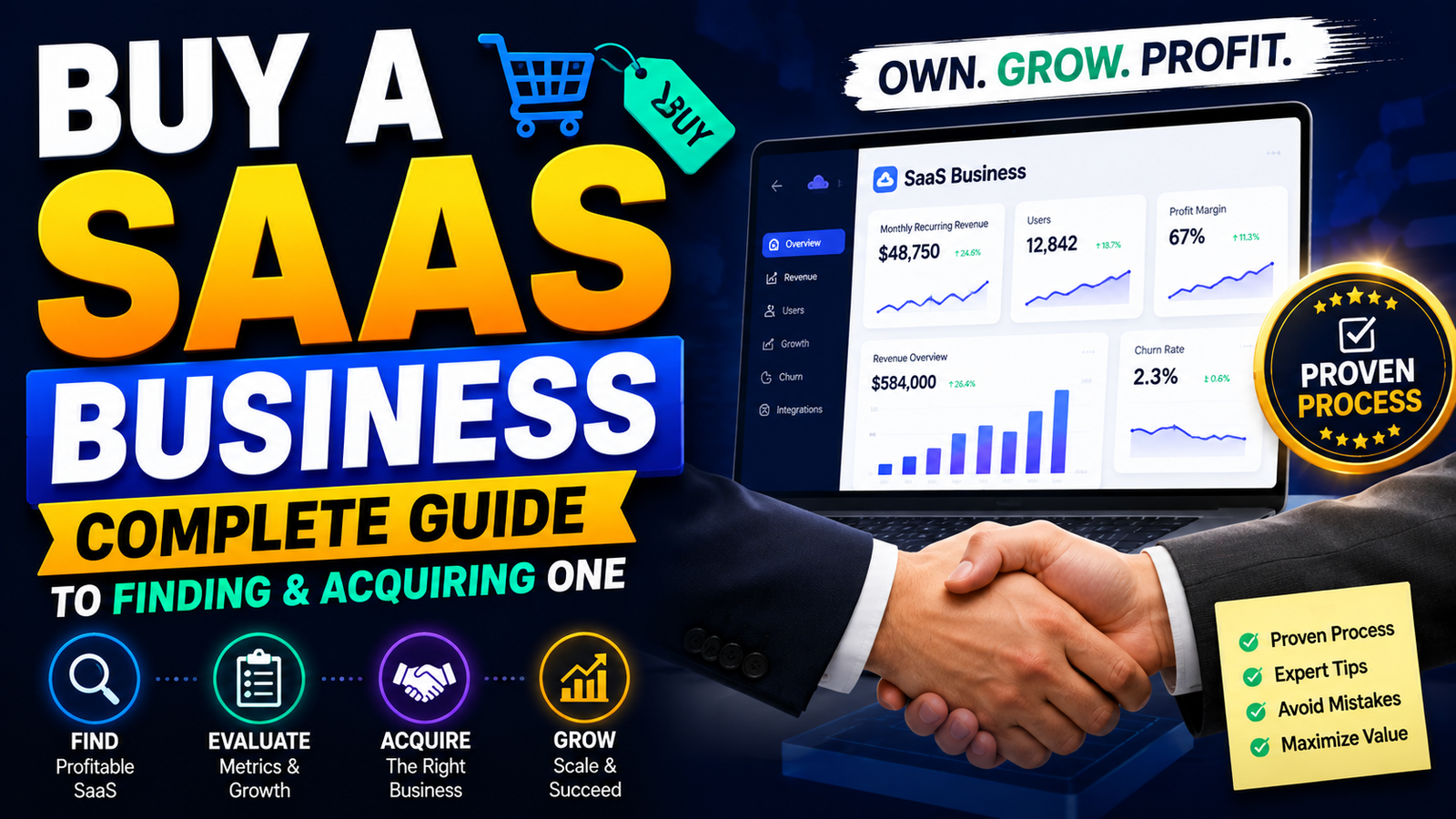

Buying an existing SaaS business can be an alternative to building a software company from scratch.
Instead of starting with an idea, developing a product, finding your first customers, and waiting for revenue, you can acquire an existing SaaS business with an established product, users, revenue, and operating history.
However, buying a SaaS business is not simply about finding a product with impressive revenue numbers. You need to understand its customers, recurring revenue, churn, expenses, technology, competition, and growth opportunities before making an acquisition.
This guide explains how to buy a SaaS business, what to look for, how to evaluate an opportunity, and what to check before completing the deal.
We Provide SaaS Business – Click Me
Why Buy a SaaS Business?
Building a SaaS company from scratch can take significant time and capital.
Buying an existing SaaS can provide several advantages.
Existing Revenue
An established SaaS may already generate monthly or annual recurring revenue.
Existing Customers
Instead of starting customer acquisition from zero, you may inherit an existing customer base.
Proven Product
You can evaluate actual customer usage and feedback rather than relying entirely on assumptions.
Existing Infrastructure
The business may already have:
- Website
- Software product
- Hosting infrastructure
- Payment systems
- Analytics
- Customer support processes
- Documentation
Growth Opportunities
An established SaaS may have opportunities to grow through better marketing, pricing, SEO, product development, or sales.
Where Can You Buy a SaaS Business?
There are several ways to find SaaS businesses for sale.
SaaS Acquisition Marketplaces
Online marketplaces specialize in businesses and digital products available for acquisition.
Founder Networks
Some SaaS founders sell directly through their professional networks.
Brokers
Business brokers can help buyers find and evaluate acquisition opportunities.
Direct Outreach
You can identify SaaS products you believe have potential and approach their founders directly.
When comparing opportunities, don’t focus only on the asking price. Examine the business behind the listing.
Get Your SaaS Business – Click Me
How Much Does It Cost to Buy a SaaS Business?
There is no universal price for a SaaS company.
The acquisition price can depend on:
- Recurring revenue
- Profitability
- Growth rate
- Customer retention
- Churn
- Market size
- Product quality
- Founder dependency
- Technology
- Competitive position
A SaaS with predictable recurring revenue and strong retention can command a very different valuation from a business with declining revenue and high customer churn.
Simple Example
Imagine a SaaS business generating:
$10,000 MRR
That means approximately:
$120,000 ARR
A buyer might value the business based on a combination of its revenue, profit, growth, retention, and other characteristics.
The exact valuation multiple varies considerably by business quality and market conditions, so revenue alone should never be used to determine what a SaaS is worth.
What to Check Before Buying a SaaS Business
This is one of the most important parts of the acquisition process.
1. Monthly Recurring Revenue
Review the company’s MRR over time.
Don’t just ask:
“How much revenue does the business make?”
Ask:
“How has revenue changed over the last 12–24 months?”
Look for:
- Growth
- Stability
- Seasonality
- Declines
- Revenue concentration
2. Annual Recurring Revenue
ARR gives you a broader view of recurring subscription revenue.
Compare current ARR with historical numbers to understand the company’s growth trajectory.
3. Customer Churn
Churn tells you how many customers or how much revenue the company loses over time.
High churn can indicate:
- Poor product-market fit
- Weak customer support
- Pricing problems
- Strong competition
- Product limitations
A SaaS with strong acquisition but poor retention may not be as attractive as its revenue initially suggests.
4. Customer Acquisition
Find out where customers come from.
Possible acquisition channels include:
- SEO
- Paid advertising
- Google Ads
- Social media
- Content marketing
- Affiliates
- Partnerships
- Outbound sales
- Product-led growth
A business dependent on one acquisition channel can carry additional risk.
One Click Away – Click Me
Check the Customer Base
Don’t just look at the total number of customers.
Understand:
- Number of paying customers
- Average revenue per customer
- Customer concentration
- Customer lifetime
- Enterprise vs individual customers
- Geographic distribution
If one customer generates a large percentage of revenue, losing that customer could significantly affect the business.
Review the SaaS Technology
Before purchasing, understand what you’re actually acquiring.
Review:
- Source code
- Hosting
- Database
- APIs
- Third-party integrations
- Domain
- Git repositories
- Development environment
- Deployment process
- Documentation
- Security practices
You should also determine whether the seller actually owns the intellectual property being transferred.
Review Operating Expenses
Revenue doesn’t equal profit.
Look at:
- Hosting costs
- Software subscriptions
- Employee/freelancer costs
- Marketing expenses
- Payment processing fees
- Customer support
- Development costs
- Taxes and other operating expenses
Calculate the actual profitability of the business.
Understand Founder Dependency
Ask yourself:
Can this SaaS continue operating if the founder disappears tomorrow?
If the founder personally handles:
- Sales
- Customer support
- Development
- Marketing
- Infrastructure
- Partnerships
then you may effectively be buying a job rather than a scalable business.
The more documented and automated the operations are, the easier the transition can be.
SaaS Due Diligence Checklist
Before buying, review at least these areas:
Financial
- Revenue
- MRR
- ARR
- Expenses
- Profit
- Refunds
- Payment processor records
Customers
- Customer count
- Churn
- Retention
- Customer concentration
- Acquisition channels
Product
- Source code
- Product roadmap
- Bugs
- Technical debt
- Infrastructure
Legal
- Company ownership
- Intellectual property
- Contracts
- Licenses
- Privacy policies
- Terms of service
- Existing disputes
Marketing
- Website
- SEO traffic
- Backlinks
- Paid advertising
- Email list
- Social accounts
SaaS Website Development Services: Click Here
Red Flags When Buying a SaaS Business
Be careful when you see:
Rapid Revenue Spikes
Sudden unexplained growth may not be sustainable.
High Customer Churn
High churn can indicate deeper product or market problems.
Unverified Revenue
Ask for evidence rather than relying solely on screenshots.
One Customer Dominates Revenue
This creates significant concentration risk.
Founder Does Everything
A business dependent entirely on its founder can be difficult to transition.
Poor Documentation
Lack of technical and operational documentation can increase your transition costs.
Declining Traffic
If most customers come from SEO, investigate whether organic traffic is stable or declining.
Step-by-Step SaaS Acquisition Process
A typical acquisition can follow this process:
1. Define your budget
Determine how much capital you’re comfortable investing.
2. Define your criteria
For example:
- B2B SaaS
- Profitable
- $5k–$20k MRR
- Growing customer base
- Low founder dependency
3. Find businesses
Search marketplaces, broker listings, founder networks, and direct opportunities.
4. Review the listing
Analyze revenue, customers, growth, product, and asking price.
5. Contact the seller
Request additional financial, technical, and operational information.
6. Perform due diligence
Verify the claims and investigate risks.
7. Negotiate
Discuss valuation, payment structure, transition support, and other terms.
8. Complete the transaction
Use appropriate legal and financial professionals for the acquisition.
9. Transition the business
Transfer accounts, infrastructure, customer relationships, documentation, and operational responsibilities.
Buy SaaS vs Build SaaS
| Buy SaaS | Build SaaS |
|---|---|
| Existing customers | Start from zero |
| Existing revenue | No initial revenue |
| Existing product | Build product |
| Faster entry | Longer development |
| Higher upfront cost | Lower initial acquisition cost |
| Existing problems to solve | More control from day one |
| Requires due diligence | Requires product validation |
Neither option is automatically better.
Buying can make sense when you have capital and want an existing business.
Building can make sense when you have a strong idea, technical capability, and want complete control over the product.
Is Buying a SaaS Business Worth It?
It can be—but only if the underlying business is healthy and the acquisition price makes sense.
A good SaaS acquisition may offer:
- Existing recurring revenue
- Established customers
- Proven demand
- Growth opportunities
- Operational leverage
But a bad acquisition can leave you with:
- Technical debt
- High churn
- Declining revenue
- Difficult customers
- Expensive infrastructure
- A product that is difficult to grow
The goal isn’t simply to buy a SaaS business.
The goal is to buy a SaaS business where the price, fundamentals, risks, and growth opportunities make sense together.
Frequently Asked Questions
Where can I buy a SaaS business?
You can find SaaS businesses through acquisition marketplaces, brokers, founder networks, and direct outreach.
How much money do I need to buy a SaaS business?
There is no fixed amount. SaaS acquisition prices vary significantly based on revenue, profitability, growth, retention, and other factors.
Is buying a SaaS better than building one?
It depends on your capital, skills, goals, and risk tolerance. Buying provides an existing business, while building gives you more control but requires starting from scratch.
What should I check before buying a SaaS?
Review financial records, MRR, ARR, churn, customers, acquisition channels, source code, infrastructure, intellectual property, operating expenses, and founder dependency.
Can I buy a SaaS business with no technical knowledge?
Yes, but you should have access to reliable technical expertise to evaluate the product, infrastructure, security, and codebase before purchasing.
Final Thoughts
Buying an existing SaaS business can be a faster route into software entrepreneurship, but due diligence is more important than the excitement of owning an established product.
Look beyond revenue screenshots and asking prices. Understand the customers, retention, profitability, technology, acquisition channels, and risks.
A SaaS business with modest revenue but strong retention, healthy margins, and clear growth opportunities can be more attractive than a larger business with declining customers and heavy founder dependency.